meta

Showing posts with label career coaching. Show all posts

Sunday, 25 August 2013

#Coaching The #STAR Model & Competency Based Recruitment

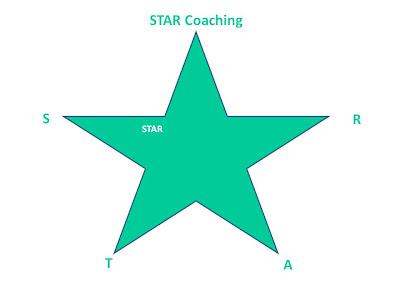
Part 3 of our series on coaching looks at the STAR model, which is a 4 step model which focuses on the future. It provides a framework for assessing the current situation, defining what changes you want or need to make, how these will be actioned and how you will review success.

Are You a Star in the Making?

The model is question based at each stage.

Situation:
(What problem are you trying to solve?)
  • What is the specific situation?
  • What is causing difficulty?
  • What is happening now?
  • What are you doing now that is not having a positive impact?
  • What thoughts are on your mind?
  • What reaction do you want from others?
Target:
(What do you want to achieve?)
  • What would you like to be different – what are the deadlines?
  • What is the desired end state?
  • What are the success measures?
  • Are they achievable? By when?
Actions:
(What is your plan?)
  • What can you do to change the situation?
  • What are the options?
  • Are there alternatives?
  • Which are most practical?
  • How & When?
  • How can you ensure you have stakeholder support?
Results:
(How do you know if you are successful?)
  • What is the desired result?
  • How will your review success?
  • How do you want to feel as a result?
Example:

Using our earlier example of Iam Capable from the “Coaching– How Do you Make it Happen” post

“You manage a large team of mixed capability. One of your team members Iam Capable requests a career development discussion with you. He is worried about the lack of career progression and thinks he has to move teams to achieve the stretch and challenge he seeks.”

Now using the STAR model:

S – The situation is that Iam Capable feels there is a lack of opportunities - his perception is that promotions are awarded to “favourites”. He is sceptical about whether there are going to be career progression opportunities for him and he feels his career is stagnating. He has applied for a promotion before, but not even been selected at the first stage of the process. You know that promotions are competency based.

T - The target is for him to be selected for the initial stage of the promotion process. Ideally this will be in the next round of promotions, which you know to be in 6 months time. You also recognise, that whilst capable, he has skills gaps compared to his peer group. Together you devise a focused skills competency development plan, with the targeted delivery date of 5 months. You discuss with him that these timeframes are a stretch target and that the required full competency development might not be possible in these timeframes. You make him aware of a further round of promotions and reassure him that he is “on your radar”.

A – There are a number of actions you could take to achieve accelerated development – coaching, mentoring, e-learning, classroom training or a blended approach. Alternatively you could move him to another team to ensure he gains the knowledge. Together you evaluate the options. Due to work priorities a team move is not possible. You opt for a mentor who will help him focus on his strengths, give him the confidence he needs and help raise his profile. It’s a partnership approach - Iam Capable (is indeed capable of a promotion!) and he now needs to work with his mentor, driving that relationship, taking the ownership for developing his skills.

R – the review is whether he is successful in progressing to the initial stages of the selection process either in 6 months time or in the following round. The ultimate measure is if he is successful at interview – which will be down to his self confidence and the developmental opportunities he has undertaken. You want to be regarded as a manager who develops their staff and for your areas to be regarded as a placement of choice, due to the career opportunities they afford.

The STAR model is also a tool commonly used by government departments and the public sector for competency based job application processes. For competency based recruitment give thought to how you can demonstrate:
  1. What was the problem?
  2. What did you need to do?
  3. How did you plan?
  4. What did success look like?

Tuesday, 4 June 2013

How to Start Formulating Your #Career Strategy

Part 2 of our series on career management. 
  
We have been exploring what is career management, with a view to helping individuals devise their own career management strategies.

Previously we identified the elements of career management as:
The First Step Is To Define The Elements Of Your Career Strategy
 The Next Steps:

In the spirit of owning and shaping your personal career strategy it is necessary to do some preparation work up front. This helps to ensure that you get the most effective career management strategy possible. Give some thought to the first things you will need in order to begin to define your career strategy. I would suggest the following:
  • Interests
  • Values
  • Goals
  • Drivers
  • Vision/Career Direction 
Break Down The Components of Your Career Strategy
Below are some ideas to get you started, it is not an exhaustive list. Do ask yourself the questions and answer them honestly - you may surprise yourself by getting different answers than you expected!


Interests:
  • Does the content of any job need to be aligned to your own interests?
  • Are you already interested in a particular sector/industry?
  • Will the job/career you are considering allow you to follow/continue to follow your own interests?

Values:
  • What is important to you in general - what makes you tick?
  • What values are you seeking in an employer?
  • When considering an employer is a particular brand or market position important?
  • Is being able to make a difference important to you?
  • Do you need to feel valued through pay and benefits?
  • Do you value family and work-life balance? Is flexible working essential?
Goals:
  • What is important to you right now?
  • What is your most important priority?
  • Where do you want to be in x time?
  • What outcome are you seeking in this situation?
Drivers:
  • Do you need autonomy?
  • Are you a decision maker?
  • Are you motivated by recognition for having specialist expertise?
  • Do you want to be a people manager?
  • Are you highly creative?
  • Are you highly competitive and thrive on a challenge?

Vision/Career Direction:
  • Are you ambitious? What career progression do you want or need?
  • Do you want to work towards a management or more senior management position?
  • What size company do you want to work for?
  • Are you risk taker or do you seek job security?
  • What about geographic location?
  • What personal/career development do you want or need?
  • Do you see yourself swapping careers at any point?
  • Do you want to run your own business?
Still unsure about a career strategy? How about discussing some of the above with friends and family? They know us so well, so are often great at helping shape some ideas. 

Hopefully that's given you a few ideas for a starting point. In Part 3 we will be discussing skills, experience and growth and the role they have to play in a personal career strategy.

Good luck with developing your personal career strategy. If you require any help and advice we can be contacted at Help With Formulating a Career Strategy

Tuesday, 16 April 2013

CV Writing and Career Management from the One Stop Career Shop

Do you need a CV refreshed or a bespoke CV professionally written? 
Are you looking for a new job? 
Do you need some career coaching? 
Or perhaps some presentation and interview skills coaching? 

One Stop Career Shop www.onestopcareershop.co.uk can help with all your career management needs.


Saturday, 13 April 2013

Is There Equality In Executive Recruitment?

Apparently this article published in The Guardian in December 2012 suggests NOT http://www.guardian.co.uk/business/2012/dec/12/research-lack-women-executive-roles. Despite having cracked many equality barriers it appears women have still not managed to smash through the senior management recruitment ceiling.

A Guardian article of 11th April 2013 refers to a recent Cranfield School of Management study, which would appear to highlight that the gender gap at senior levels is still an issue http://www.guardian.co.uk/commentisfree/2013/apr/11/every-woman-boardroom-pull-more-up

In the article Karen Brady is quoted as saying:

"Every woman in the boardroom must pull others up behind her"

Sadly I feel this is not common practice. It is also a bit of a chicken and egg situation - more women are needed at senior levels to help nurture new female talent of the future. At the One Stop Career Shop http://www.onestopcareershop.co.uk/Career-Coaching.php I regularly encounter female clients who are struggling to gain that executive promotion, despite having all the requisite skills. I see them becoming more despondent and disillusioned with their employers and ultimately they look to move on to pastures new. Surely this can't be a good thing?

What can be done?
I firmly believe that quotas are not the way to go - they are artificial and create resentment. True equality should be gained on merit. What is needed is for employers to recognise the value of a varied skill set at executive level and for them to create a working environment where this is allowed to flourish. Only that way will women achieve senior promotions. 
I am myself a manager in a blue-chip organisation and I think we all have a role to play in developing those who work for us, male or female. 
Karen Brady - an inspirational female executive, we just need more!  Photo attributed to johnmuk


Monday, 1 April 2013

What Does Career Management Mean to You?


Part 1 of our series on career management. 
In the coming weeks we are going to be exploring what is career management, with a view to helping individuals devise their own career management strategies.


Recently on LinkedIn I ran a poll on what others associated with career mentoring. 
The results were as follows:
50% wanted help to formulate a career strategy 
20% wanted help in establishing what is important to them in driving their career
20% were seeking help and support with job applications  
10% wanted help to identify a career direction in terms of role/sector

This led me to thinking that the components required for an effective career strategy was probably a good topic to launch our blog.  

I particularly liked the picture above which got me thinking about what to consider for an effective career strategy. Other factors I thought of were:  

  • Contribution 
  •  Knowledge 
  •  Perseverance 
  •  Responsibility 
  •  Growth 
  •  Potential 
  •  Performance 
  •  Development 
  • Training 
  •  Ability 
  •  Management 
  • Experience 
I have clustered these component parts loosely as follows and will cover them in future posts